

Tianwen-1 Captures Interstellar Comet 3I/ATLAS from Mars Orbit
science-and-technology

Tianwen-1 Captures Interstellar Comet 3I/ATLAS from Mars Orbit

By Editorial TeamJul 27, 2026 · 5:23 AM3 min read
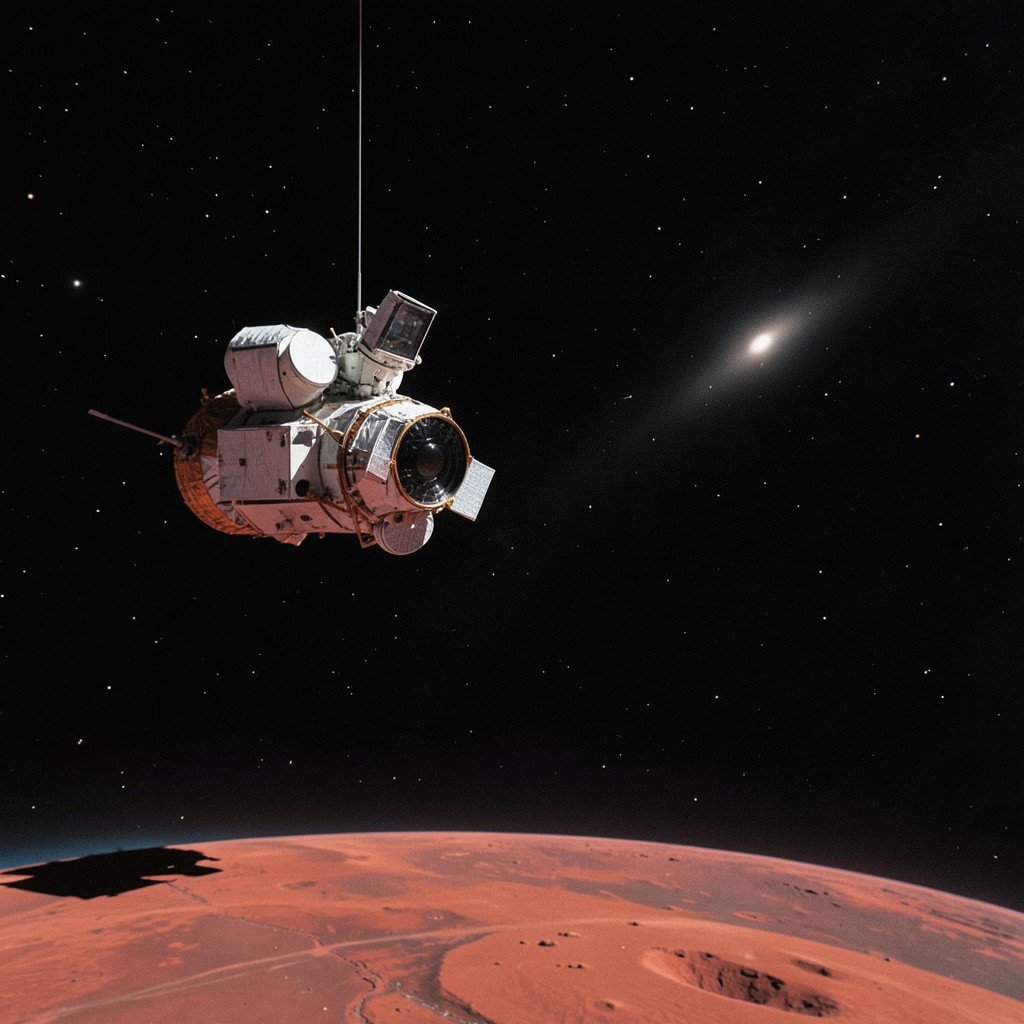
AI-generated representative image: An artist's conception of China's Tianwen-1 orbiter at Mars capturing the interstellar comet 3I/ATLAS, a faint object traveli
Editorial Team
Editorial Team
China's Mars orbiter uses HiRIC camera to photograph the rare interstellar comet's tail and coma

China's Tianwen-1 spacecraft has successfully photographed interstellar comet 3I/ATLAS from its position in Mars orbit, capturing a visible tail and surrounding coma that confirm the object's cometary nature. The observation, conducted using the orbiter's High-Resolution Imaging Camera (HiRIC), places Tianwen-1 among the closest spacecraft to study the interstellar visitor since its discovery on May 7, 2025.

The achievement marks only the third time humanity has identified and studied an interstellar object passing through the solar system. Such visitors offer rare scientific opportunities: they carry pristine material from their home star systems, potentially holding clues about how other planetary systems formed and what chemical building blocks they contain.

What the Images Reveal

The new images from Tianwen-1 display a distinct tail extending behind the comet and a cloud of gas and dust, known as a coma, enveloping its nucleus. These features strongly support classifying 3I/ATLAS as a comet rather than an asteroid.

Researchers stitched multiple frames into an animation tracing the comet's trajectory as it approaches perihelion, its closest point to the Sun. The findings add weight to evidence that 3I/ATLAS harbors water and other volatile materials that began escaping as solar heating intensified during its passage through the inner solar system.

China's Mars Mission and Future Plans

Tianwen-1 has been orbiting Mars for four years and eight months, far exceeding its original mission parameters. The successful comet observation serves as a technical preview for China's upcoming Tianwen-2 mission, which is designed to visit a Near Earth Asteroid and subsequently study a comet up close.

The comet 3I/ATLAS follows two previously identified interstellar objects. These rare visitors are considered invaluable to both astronomy and astrobiology because asteroids and comets preserve leftover material from planetary formation. An interstellar object may therefore contain direct evidence of conditions around another star, something that would otherwise require an enormously expensive and time-consuming interstellar probe mission to obtain.

The Technical Challenge of a Dim, Fast Target

The HiRIC team began preparations in early September, conducting repeated simulations, theoretical modeling, and detailed instrument inspections. Photographing 3I/ATLAS presented formidable obstacles: the comet measures only 5.6 kilometers (3.5 miles) in diameter and was traveling at roughly 58 km/s (36 mi/s), with a relative velocity to Tianwen-1 reaching approximately 86 km/s (53.5 mi/s).

HiRIC was originally designed to image bright Martian surface features, not faint deep-space objects. On October 3, European Space Agency orbiters Mars Express and ExoMars Trace Gas Orbiter also photographed the comet using their HRSC and CaSSIS instruments respectively. Compared to sunlit Martian terrain, 3I/ATLAS appeared 10,000 to 100,000 times fainter. While HiRIC's exact exposure time remains undisclosed, its precision timing and rapid-operation engineering enabled the successful capture, though the resulting image is grainy and blurry.

What Comes Next

3I/ATLAS continues its journey toward perihelion, and scientists worldwide are analyzing the combined observations from Tianwen-1, Mars Express, and ExoMars to extract maximum data from this rare encounter. Looking further ahead, the European Space Agency's Comet Interceptor mission, slated for completion by 2029, is being designed to wait in space for an opportunity to investigate a suitable comet or other promising target at close range, potentially including future interstellar visitors.

MORE LIKE THIS

Comments (0)

Leave a comment

A verified Gmail account is required to post comments.

No comments yet. Be the first to share your thoughts!