

OpenAI AI Models Make Discoveries in Mathematics, Physics
science-and-technology

OpenAI AI Models Make Discoveries in Mathematics, Physics

By Editorial Team•Oct 27, 2026 · 8:28 AM•3 min read
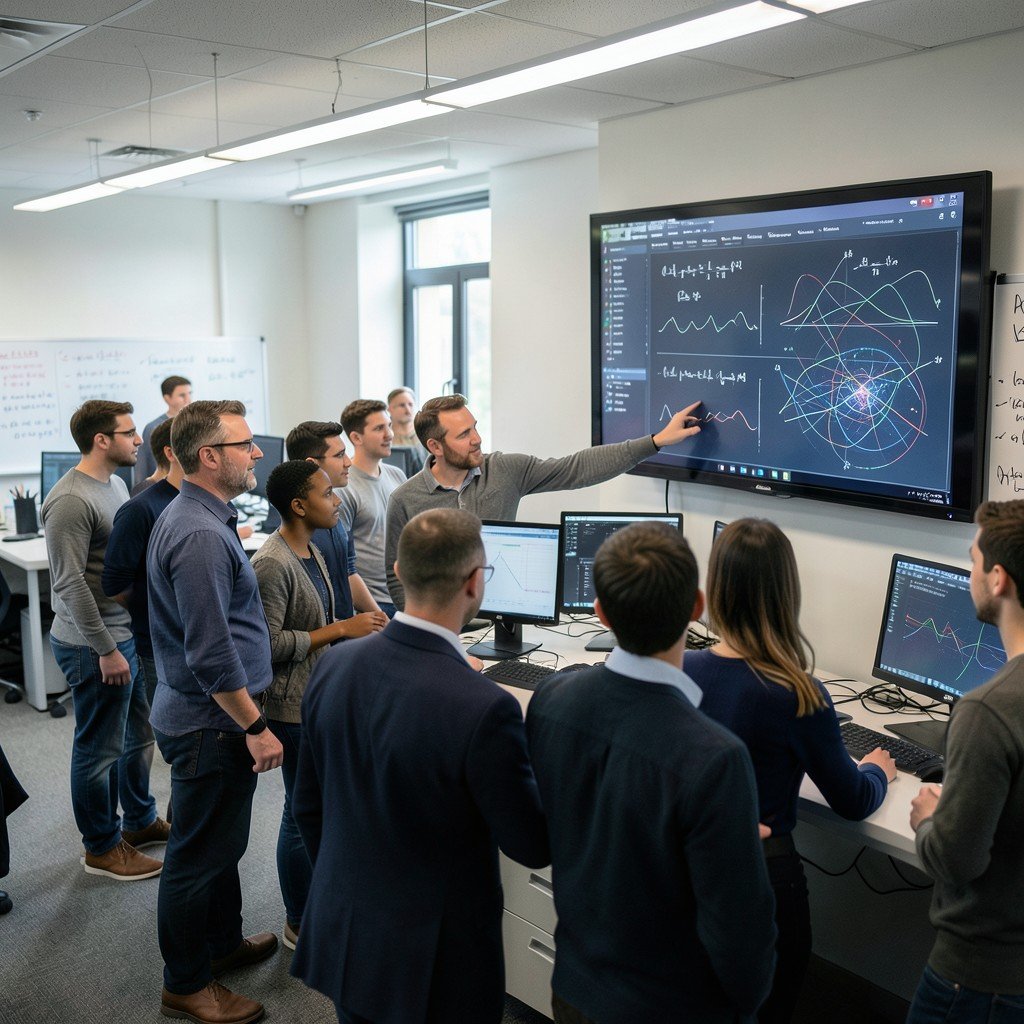
AI-generated representative image: Researchers review AI-assisted results in a laboratory setting, illustrating the use of AI models in mathematical and physics
Editorial Team
Editorial Team
Three breakthroughs in harmonic analysis, complexity theory and quantum chromodynamics include a proof of a long-standing conjecture.

OpenAI announced on Monday that its artificial intelligence models have produced several scientific discoveries across mathematics, computer science and physics, including the first-ever proof of a central mathematical conjecture in every spatial dimension.

The San Francisco-based company said the three new findings concern the fields of harmonic analysis, complexity theory and quantum field theory.

The announcement marks a significant milestone in the growing use of AI to advance fundamental scientific research. If the discoveries withstand scrutiny from the broader academic community, they could accelerate progress in fields that have long resisted traditional mathematical approaches and reshape how theoretical research is conducted.

Three Confirmed Breakthroughs

According to OpenAI's announcement, its AI models achieved the following results:

  • Proved the local smoothing conjecture, a central proposition of harmonic analysis, in every spatial dimension for the first time. Researchers had previously only proved the theory in three dimensions.
  • Disproved the Exponential Time Hypothesis, which relates to the time required to solve complex computational problems.
  • Provided mathematically rigorous proof of the existence of quantum chromodynamics, the theory that studies the interaction of quarks and gluons.

Harmonic analysis is a branch of mathematics that studies how complex signals and functions can be broken down into elementary waves.

Background and Recent AI Breakthroughs

OpenAI's announcement is the latest in a series of claimed scientific breakthroughs credited to artificial intelligence. Last month, Anthropic, the creator of the Claude AI assistant, announced the discovery of a new enzyme said to resemble CRISPR, the gene editing mechanism used in treating conditions such as cancer and sickle cell disease.

Anthropic's announcement drew mixed reactions from scientists. While some researchers hailed the finding as an exciting development, others suggested the company had exaggerated its significance. OpenAI's latest claims are likely to face similar scrutiny as independent experts evaluate the AI-generated results.

Expert Reaction and Release Strategy

Alex Iosevich, a professor of mathematics at the University of Rochester who specialises in harmonic analysis, described OpenAI's apparent solution of the local smoothing conjecture as a "historic development." The conjecture was formulated by his PhD adviser, Chris Sogge.

"Now I am filled with joy and optimism, because the scientific enterprise as a whole is going to make giant leaps as a result of the AI revolution, and we have the chance to be a part of this historic development," Iosevich said.

Iosevich added that he expected theoretical mathematics to "change drastically" due to AI, noting that many problems in pure mathematics originated from concrete physical considerations that can now be explored rapidly.

OpenAI said it consulted three expert groups chosen to act as "shepherds" in deciding how to release the findings. The mathematics and computer science groups opted to make the AI-produced data public immediately, while the physics group deferred release to write its own interpretation of the results. The company, valued at $852 billion, acknowledged that all approaches involve tradeoffs and welcomed feedback on broadening participation.

What Happens Next

OpenAI said it has reached out to scientists outside the company to help turn its "raw research data into scientific understanding." The physics-related findings remain under review pending the collaborating group's written interpretation, while the mathematics and computer science data are already publicly available for independent verification by the academic community.

MORE LIKE THIS

Comments (0)

Leave a comment

A verified Gmail account is required to post comments.

No comments yet. Be the first to share your thoughts!