

India Surfing Makes Historic Asian Games Debut in Japan
sports

India Surfing Makes Historic Asian Games Debut in Japan

By Editorial TeamSep 24, 2026 · 1:20 PM4 min read
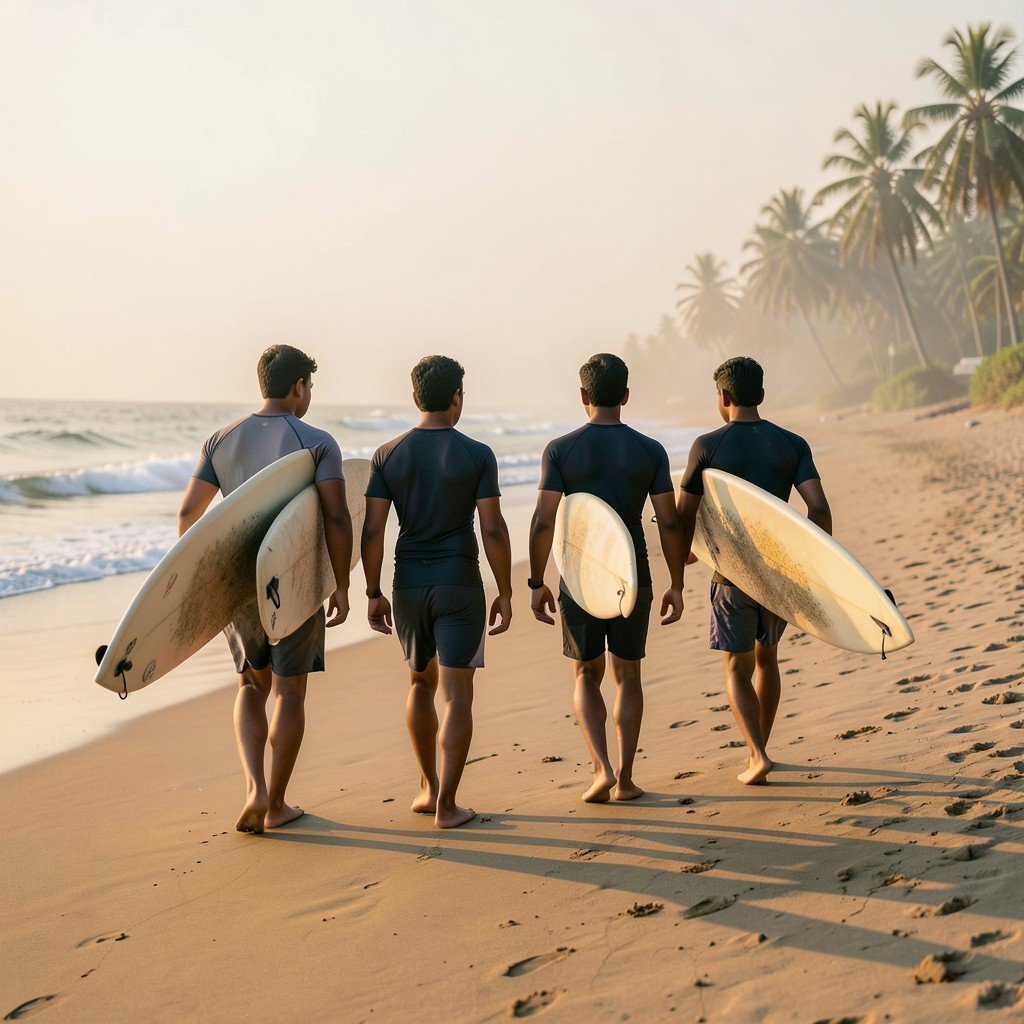
AI-generated representative image: Indian surfers carry their boards toward the sea ahead of surfing's historic Asian Games debut.
Editorial Team
Editorial Team
Sugar Shanti Banarse, Kamali Moorthy, Kishore Kumar and Sivaraj Babu lead India's first surfing team at the Asian Games

Four Indian surfers will represent the country as surfing makes its debut at the Asian Games in Japan this September, marking a milestone for a sport that has struggled for years to gain structure and recognition in India. The team comprises Sugar Shanti Banarse, 20, Kamali Moorthy, 16, Kishore Kumar, 18, and Sivaraj Babu, 22, who will compete against the continent's best talent from Friday until Tuesday.

The team's participation reflects a dramatic turnaround for Indian surfing, which only recently secured official government recognition and funding. The development matters because it signals the arrival of a sport long overlooked despite India's thousands of miles of coastline, and it offers young athletes from fishing communities a legitimate pathway to international competition.

Major Milestones for Indian Surfing

The Surfing Federation of India (SFI), launched in 2011, gained official recognition from the Ministry of Youth Affairs and Sports in March 2025, unlocking funds through the government-run Sports Authority of India and bringing long-sought stability to the governing body.

Under president Arun Vasu, who took over in 2020, the SFI secured Corporate Social Responsibility funding from the TT Group, where he serves as chairman and managing director, to support a handful of athletes. The federation has since hosted prestigious events including the World Surf League series and the Asian Surfing Championships.

Indian surfers have shown competitive promise, with Ramesh Budihal taking bronze at the Asian Surfing Championships in August 2025 and Kumar winning silver at the Asian ProAm Surf Series months later.

From Humble Beginnings to International Stage

India's first generation of surfers had little support. Team coach Samai Reboul, who grew up near Auroville in Tamil Nadu, recalled watching holidaymakers surf in the late 1990s and borrowing a board when he could. "I grew up at a time when there were no coaches, no access to training material and no surfboards," he said.

The current athletes came to the sport through varied routes. Banarse, from Mandrem in Goa, first tried surfing after accompanying a friend to a surf school. Moorthy's uncle, a surf instructor, gave her the first lesson off the coast of Mahabalipuram. Kumar and Babu, who hail from fishing families in Kovalam and Mahabalipuram respectively, began by body surfing before progressing to boards, often using equipment in exchange for chores at a local school.

Family acceptance was slow. Kumar's family considered surfing a waste of time, while Babu was expected to help his father with fishing. Moorthy's mother, who runs a beach shack, worried about the harsh sun affecting her daughter's complexion before ultimately supporting her pursuit.

Training and Development Efforts

Preparation for the Asian Games has intensified under Reboul, who began monitoring the team and refining technique during camps. A sports psychologist addressed the mental side of competition, while other staff focused on physical conditioning. Access to cameras and video analysis software allowed athletes to send footage for feedback even outside of camp.

"Besides quality equipment, what really changed was access to cameras and software for video analysis," Reboul said.

At the Asian Championships last year, Kumar beat Ikko Watanabe of Japan, a result Reboul cited as proof that Indian surfers can compete with the region's best. The SFI has also joined the Asian Surf Ecosystem's Grom Patrol and runs three age group contests, for under-12s, under-14s and under-16s, with winners qualifying for a final in Bali.

What Lies Ahead

India remains a young surfing nation compared with Indonesia and Japan, and challenges persist. The monsoon season forces surfers to shuttle between coasts or train abroad year-round, requiring significant resources, and there is a need for more skilled coaches. This year the SFI brought in experienced coach Ivan Villalba to run a training programme.

Competing at the Asian Games is seen as valuable exposure for the current athletes, particularly with the Los Angeles Olympics in 2028 on the horizon. "The dream is to represent India at the Olympics," Kumar said.

MORE LIKE THIS

Comments (0)

Leave a comment

A verified Gmail account is required to post comments.

No comments yet. Be the first to share your thoughts!