
France Protests: 70,000 Police Deployed Ahead of Weekend Unrest
news

France Protests: 70,000 Police Deployed Ahead of Weekend Unrest

By Editorial Team•Oct 24, 2026 · 11:27 AM•4 min read
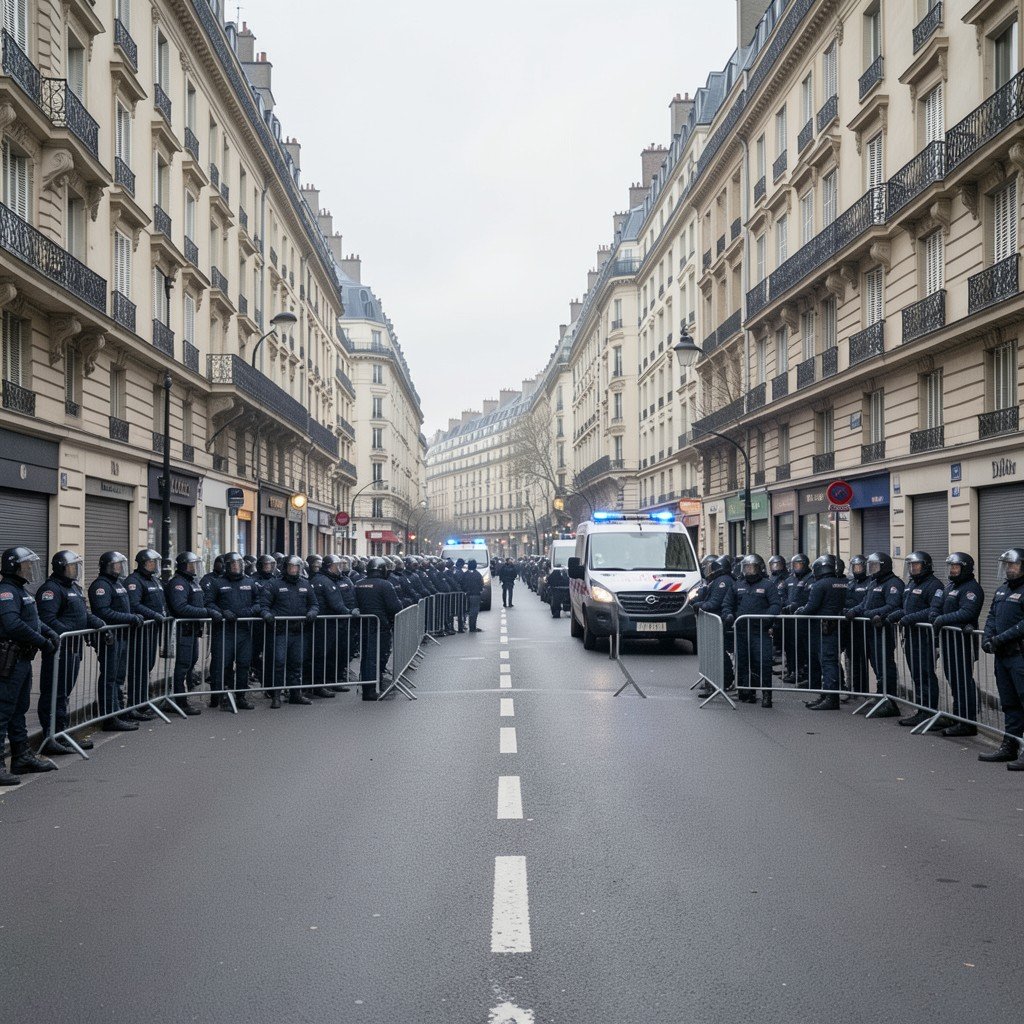
AI-generated representative image: Riot police stand behind barricades on a Paris street ahead of weekend protests in France.
Editorial Team
Editorial Team
Macron government imposes sweeping protest restrictions after last weekend's violence damaged thousands of businesses

More than 70,000 police officers and gendarmes are being deployed across France as the country prepares for a new round of protests on Saturday over deteriorating school conditions and the rising cost of living. The massive security operation comes one week after largely peaceful demonstrations descended into widespread looting, vandalism and clashes.

Authorities have made clear they are determined to prevent a repeat of the October 17 unrest, which saw thousands of businesses damaged or ransacked and more than 2,000 people taken into police custody, according to official figures.

The demonstrations, which began in mid-September as student blockades over school conditions, have grown into a broader movement against the cost of living, inequality and President Emmanuel Macron's presidency. The unrest is unfolding just six months before a pivotal presidential election, heightening its political significance.

The response has drawn criticism from rights groups, who warn that sweeping restrictions on demonstrations threaten the right to peaceful protest.

Major Security Operation and Protest Bans

Interior Minister Laurent Nunez said 20 percent more officers would be deployed than during the previous weekend. The operation will also involve RAID, an elite police unit usually tasked with counterterrorism, whose officers will support other police operations rather than engage directly in crowd control.

Authorities have adopted a highly restrictive approach to Saturday's demonstrations. President Macron said requests to protest from trade unions would be examined by local authorities, while demonstrations organised by other groups would be banned wherever possible.

  • Montpellier, Rouen and Nice: protests prohibited in downtown areas.
  • Lyon: demonstrations banned in the city centre.
  • Marseille: a union-organised march authorised under strict conditions.
  • Paris: a union coalition march rerouted to the city's edge, from Porte d'Italie to Porte de Vincennes along the Boulevards des Marechaux, between 1pm and 7pm.
Origins of the Protest Movement

The protests began in mid-September, when high school students blockaded their schools over what they described as deteriorating conditions, including dilapidated buildings and teacher shortages, as well as what they see as an unfair system for accessing higher education.

The movement has since become a focal point for wider discontent over the cost of living, inequality and Macron's presidency. On October 17, more than half a million people took to the streets following calls from student organisations and remnants of the Yellow Vest movement.

The unrest also carries electoral weight. Macron, constitutionally barred from seeking a third consecutive term, will leave office in 2027. The violence has put renewed focus on the far right, whose leading figure, Marine Le Pen, has long campaigned on restoring law and order. Recent polls have placed her as the leading presidential contender by a wide margin.

Official Statements and Citywide Precautions

Amnesty International France condemned the security measures, stating: "This security escalation comes at the expense of our freedoms, seriously endangering the right to demonstrate peacefully and raising fears of a further escalation of violence in our country."

In central Paris, businesses were shuttered and shop windows covered with protective panels, while some retailers hired private security. At least 24 metro stations were closed at the request of the police prefecture. Major cultural institutions, including the Louvre and the Musee d'Orsay, also closed for the day, while Art Basel Paris cancelled its weekend programme.

On Friday, Macron met representatives of the student movement for the first time since the protests began. He promised more teachers and a deep overhaul of Parcoursup, the university admission system, but the meeting failed to defuse tensions, with student representatives calling for further mobilisation until the government presents concrete actions.

What Lies Ahead

Tensions are also expected in Orleans, where Le Pen's National Rally is holding its party congress on Saturday, marking the start of its presidential campaign. Authorities expect between 20,000 and 30,000 people to join a counter-demonstration against the far-right party, prompting a major security operation.

Student representatives have signalled that mobilisation will continue until the government presents concrete actions, suggesting further demonstrations remain likely in the days ahead.

MORE LIKE THIS

Comments (0)

Leave a comment

A verified Gmail account is required to post comments.

No comments yet. Be the first to share your thoughts!