
Gaza Oxygen Crisis Leaves Patients Dependent on Dwindling Supply
news

Gaza Oxygen Crisis Leaves Patients Dependent on Dwindling Supply

By Editorial TeamSep 9, 2026 · 8:36 PM3 min read
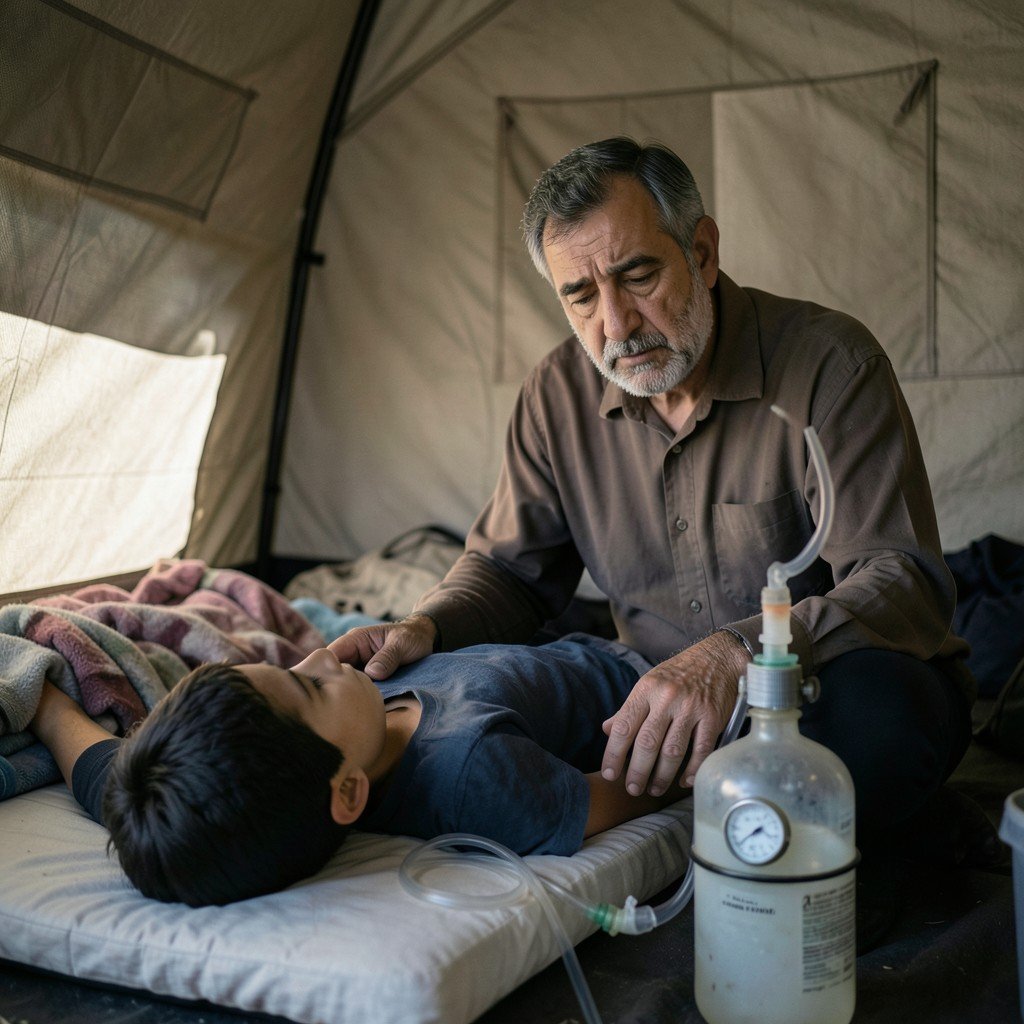
AI-generated representative image: A father watches over his oxygen-dependent son inside a displacement tent in Gaza amid a critical medical oxygen shortage.
Editorial Team
Editorial Team
Only 12 of 34 oxygen stations remain operational as respiratory patients face life-threatening shortages

Ali Humaida watches the gauge on his son's oxygen cylinder fall inside the family's tent in az-Zuwayda, central Gaza, knowing that when it empties, his 14-year-old son Abdulaziz could stop breathing. Gaza's Ministry of Health warned on August 15 that only 12 of the strip's 34 oxygen-generation stations remain operational, while just four of 30 cylinder-filling devices still work, leaving families who care for oxygen-dependent patients outside hospitals facing increasingly dangerous shortages.

The oxygen shortage is part of a broader collapse of Gaza's health system, which has been devastated by Israeli attacks and restrictions on medical supplies and equipment. For patients like Abdulaziz, who depends on a continuous supply of supplemental oxygen, every interruption risks brain damage, organ failure, or death, making this crisis a matter of immediate life and death for some of Gaza's most vulnerable residents.

Critical Shortages Across the Strip

The Ministry of Health attributes the majority of oxygen-generation stations being out of service to systematic Israeli restrictions at border crossings. Israeli authorities continue to restrict and ban the entry of spare parts and specialised lubricants for hospital generators and oxygen plants, while also blocking new plants meant to compensate for the shortage.

Israel classifies oxygen cylinders, accompanying devices and electrical generators as "dual-use" items, prohibiting their entry or spare parts through closed crossings. As a result, the Ministry of Health and several hospitals have completely halted external oxygen cylinder refilling services for patients receiving care at home or in displacement tents, a measure officials describe as forced by the system nearing collapse.


Abdulaziz's Medical History

Abdulaziz has lived with serious health problems since birth, including a congenital heart defect and underdeveloped lungs. Since childhood he has also suffered from hydrocephalus, or cerebrospinal fluid buildup in the brain, and underwent surgery to insert a ventriculoperitoneal (VP) shunt that drains excess fluid. He also has autism spectrum disorder and requires extensive daily care.

Before the war, Abdulaziz received regular specialised treatment at a hospital in Israel, but that has stopped, leaving the family dependent on Gaza's devastated health system. His father estimates that medicine, diapers and transportation now cost between 950 and 1,100 shekels ($315 and $365) a month, double pre-war prices.

Medical and Statistical Evidence

Dr Ghada Hassouna, a physician at al-Aqsa Martyr's Hospital in Deir el-Balah, said a patient whose oxygen saturation level plummets can develop rapid breathing, a faster heart rate and cyanosis, a bluish discolouration of the skin caused by poor oxygen and blood flow. Inadequate oxygen can damage vital organs, particularly the brain and heart, and brain cells are exceptionally sensitive to oxygen deprivation.

The United Nations estimates about 350,000 people in Gaza are living with chronic diseases, with treatments severely disrupted by the war. Mohammad Abu Salmiya, director of al-Shifa Medical Complex, said Gaza is coping with shortages of half of essential medicines and more than 80 percent of laboratory materials, estimating that about 21,000 patients and wounded people need treatment outside Gaza.

What Lies Ahead

For now, patients in Gaza must make do with what is available inside the enclave. Abdulaziz's family measures time by what remains in his oxygen cylinder, and his father says they need a stable supply until he can travel to resume treatment. No timeline has been confirmed for restoring oxygen-generation capacity or reopening refilling services, and additional information on the situation remains awaited.

MORE LIKE THIS

Comments (0)

Leave a comment

A verified Gmail account is required to post comments.

No comments yet. Be the first to share your thoughts!